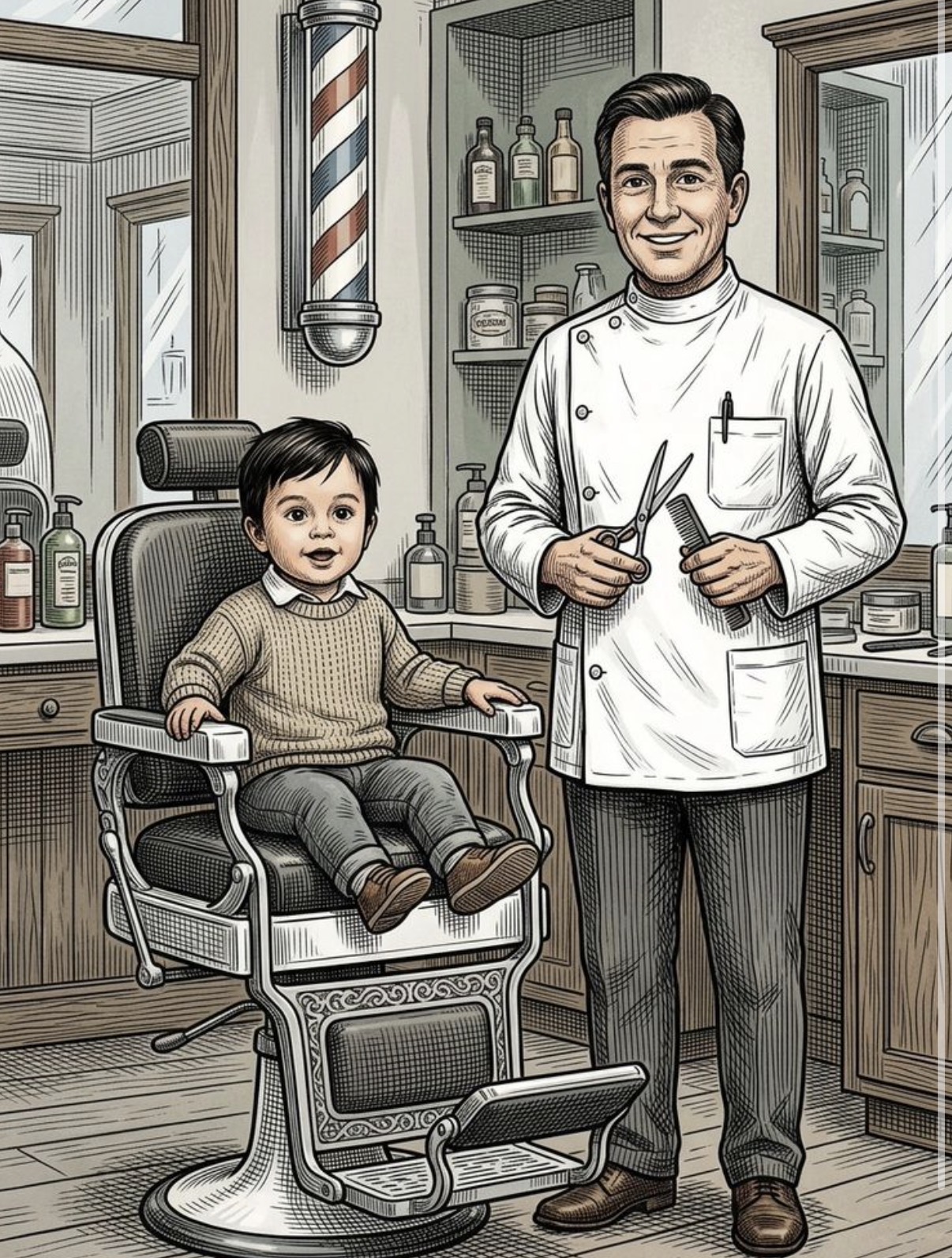
If your toddler screams at the barber, your child refuses to sit in the salon chair, or haircut time has become a full-blown meltdown, you're not alone. Fear of haircuts is one of the most common childhood anxieties, and it affects kids of all ages and neurotypes.
The good news? There's a simple, research-backed way to help your child feel calm before, during, and after a haircut. It doesn't involve bribery, screen time, or holding them down. It starts with a story.
Most children aren't afraid of the haircut itself. They're afraid of what they don't understand.
Why are kids scared of haircuts?
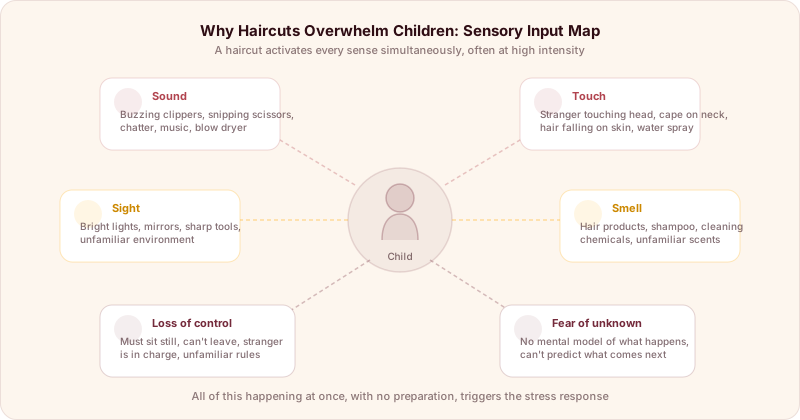
To an adult, a haircut is routine. To a small child, it can be overwhelming. Here's what's actually going on:
- Sensory overload. The buzzing of clippers, the sound of scissors near their ears, the feeling of hair falling on their skin, the cape around their neck. For sensory-sensitive children, this can be genuinely distressing.
- Fear of the unknown. If your child has never had a haircut before, or doesn't remember the last one, they have no idea what's about to happen. That uncertainty creates anxiety.
- Loss of control. A stranger is touching their head, they have to sit still, and they can't leave. For toddlers who are just learning independence, this feels threatening.
- Bad past experiences. If a previous haircut involved crying, being held down, or pain from pulling, the child associates haircuts with fear.
Understanding the "why" is the first step to fixing it.
What doesn't work (and what does)
Many parents try these common approaches:
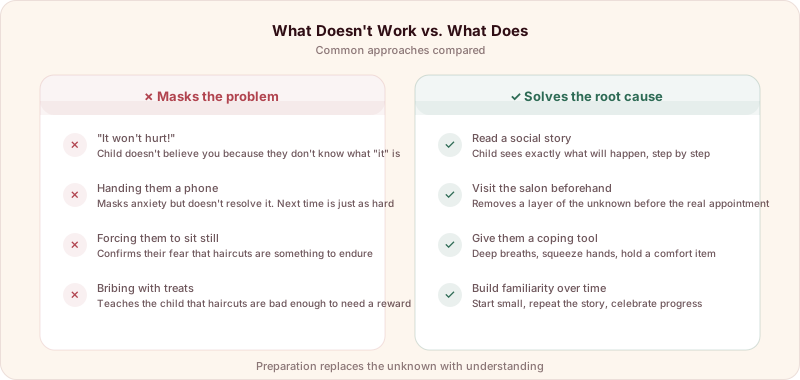
- "It won't hurt!" But the child doesn't believe you because they don't know what "it" is.
- Distracting with a phone or tablet. This masks the anxiety but doesn't resolve it. The next haircut will be just as hard.
- Forcing them to sit still. This confirms the child's fear that haircuts are something to endure, not something safe.
- Bribing with treats. This can work short-term but teaches the child that haircuts are bad enough to require a reward.
What actually works is preparation. When a child knows what will happen, step by step, the fear fades. They feel in control because they've already "experienced" it in their mind.
This is exactly what preparation stories do.
What is a social story?
A social story is a short, simple narrative that walks a child through a specific situation in calm, reassuring language. It explains what will happen, who will be there, what things will look and sound like, and what the child can do if they feel nervous.
Social Stories™ were developed by Carol Gray in 1991 and have been used for over 30 years by parents, therapists, teachers, and special educators. They were originally created for children with autism but are now widely used for all children, including neurotypical kids, toddlers, and children with ADHD, anxiety, or sensory processing differences.
A social story doesn't just tell a child what will happen. It helps them believe they can handle it.
How to use a social story for haircuts
Here's a simple approach that works for most families:
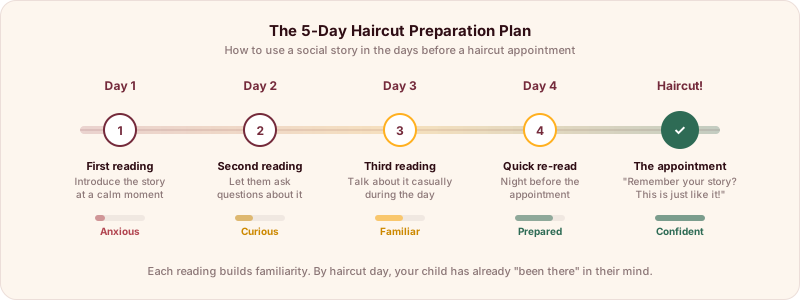
1. Read the story several days before the haircut. Don't wait until the morning of. Give your child time to absorb the information and ask questions.
2. Read it multiple times. Repetition builds familiarity. By the third or fourth reading, the story becomes something your child knows and expects.
3. Talk about it casually. "Remember in your story, the hairdresser uses a spray bottle? That's the water that helps comb your hair." Connect the story to real life.
4. Bring the story to the appointment. Some children like to hold the story or look at it in the waiting area. It's a comfort object that reinforces what they already know.
5. Keep it positive after. "You did it! Just like in your story." This builds confidence for next time.
What a haircut social story looks like
Here's an example of what a personalized haircut social story might include:
"Today I'm going to get a haircut. A haircut helps my hair look neat and feel good."
"When I get to the salon, I'll sit in a special chair. The chair might go up high so the hairdresser can reach my hair."
"The hairdresser will put a cape around my shoulders. The cape keeps the little hairs off my clothes."
"I might hear scissors going snip-snip, or feel a comb going through my hair. It doesn't hurt, but it might tickle."
"If the hairdresser uses clippers, they make a buzzing sound. The buzzing feels funny but it's just the clippers doing their job."
"If I feel nervous, I can take a deep breath, squeeze my hands together, or tell my mom how I feel."
"When it's all done, I can look in the mirror and see my new haircut. I did it!"
The key is personalization. A story works best when the child sees a character that looks like them, in a setting that matches where they'll actually go.
How Piko Story helps
Writing and illustrating a preparation story from scratch takes time that most parents don't have, especially when the haircut is tomorrow. Piko Story lets you create a complete, illustrated story in minutes.
You describe the situation, such as "my 3-year-old daughter is getting her first haircut at a kids' salon," and Piko Story generates a personalized story with:
- A character that looks like your child
- Age-appropriate language
- Step-by-step scenes covering the full haircut experience
- Calming strategies your child can use
- Beautiful illustrations that keep your child engaged
You can read it together on your phone, save it for repeat readings, and share it with your partner, grandparents, or the hairdresser themselves.
Many parents read the story 3-4 times in the days before the appointment. By haircut day, your child already knows what to expect, and that makes all the difference.
Tips for making haircuts easier (beyond the story)
These practical tips work well alongside a social story:
- Visit the salon beforehand. A quick trip to see the space, meet the hairdresser, and sit in the chair (without cutting) removes a layer of the unknown.
- Book at a quiet time. Fewer people means less sensory input. Early morning or mid-week tends to be calmer.
- Choose a kids' salon if possible. They're designed for children and the staff is experienced with nervous kids.
- Bring a comfort item. A favorite stuffed animal or toy can help your child feel grounded.
- Let your child watch you get a haircut first. Seeing a parent go through it calmly shows them there's nothing to fear.
- Don't force it. If your child is truly in distress, it's okay to stop and try again another day. Forcing it creates negative associations that make the next attempt harder.
- Start small. If your child is very anxious, start with just a trim of the bangs. Build up gradually over multiple visits.
- Use a spray bottle at home. Let your child play with water spray and combs during bath time so the sensations become familiar.
When to seek extra support
For most children, preparation through stories and gradual exposure is enough to overcome haircut anxiety. However, if your child's fear is extreme, persistent, or accompanied by other sensory sensitivities, it may be worth talking to:
- Your pediatrician to rule out sensory processing concerns
- An occupational therapist who specializes in sensory integration
- A child psychologist if the anxiety extends beyond haircuts to many everyday situations
These professionals can provide additional strategies tailored to your child's specific needs. Social stories are often one of the tools they recommend.
Frequently asked questions
Why is my toddler so scared of haircuts?
Toddlers fear haircuts primarily because of the unknown. They don't understand what's happening, the sensory experience (buzzing, snipping, hair falling) is unfamiliar, and a stranger is touching their head. This is completely normal and doesn't indicate a developmental concern.
At what age do kids stop being afraid of haircuts?
Most children become comfortable with haircuts between ages 4-6 as they gain more experience and understanding. However, some children, especially those with sensory sensitivities, may need ongoing support. Preparation through social stories can help at any age.
How do I cut my toddler's hair if they won't sit still?
Rather than trying to restrain your child, focus on preparation. Read a social story about haircuts several times before the appointment. Visit the salon beforehand so it feels familiar. During the cut, try giving them something to hold, and keep the session short. If they need a break, let them take one.
Should I cut my child's hair at home or go to a salon?
Both work. Home haircuts give you more control over the environment and pace. Salon haircuts teach the child that salons are safe places. If your child is very anxious, starting at home and graduating to a salon over time can be a good approach.
What is a social story and how does it help with haircuts?
A social story is a short, illustrated narrative that explains a specific situation to a child in simple, reassuring language. For haircuts, it walks through each step (arriving, sitting in the chair, the cape, scissors, clippers, the finished result) so the child knows exactly what to expect. Research shows that children who are prepared for new experiences through stories experience significantly less anxiety.
Do social stories work for neurotypical children or just kids with autism?
Social stories work for all children. While they were originally developed for children on the autism spectrum, research and parent experience show that any child benefits from understanding what to expect before a new or challenging situation. Neurotypical toddlers, children with ADHD, anxious kids, and sensory-sensitive children all respond well to social stories.
How many times should I read the social story before the haircut?
Read the story at least 3-4 times in the days leading up to the appointment. The more familiar the story becomes, the more confident your child will feel. Many parents also bring the story to the appointment itself as a comfort tool.
Can I make a preparation story about my child's specific salon?
Yes, and personalization makes stories more effective. With Piko Story, you can describe your child and their specific situation, and the app generates an illustrated preparation story tailored to them. The more the story matches reality, the more prepared your child will feel.
My child had a bad haircut experience. How do I fix the association?
Start by acknowledging their feelings. Then use a social story to reframe the experience. Read it at home in a calm, safe environment with no pressure. Visit the salon without getting a cut, just to sit in the chair and leave. Build positive associations gradually. It may take several visits before your child feels comfortable again, and that's okay.
Are there special techniques for cutting an autistic child's hair?
Many of the same strategies apply: social stories, gradual exposure, sensory accommodations (noise-canceling headphones, no cape if it bothers them, dry cuts instead of wet). Some salons specialize in sensory-friendly haircuts. An occupational therapist can also provide specific recommendations based on your child's sensory profile.