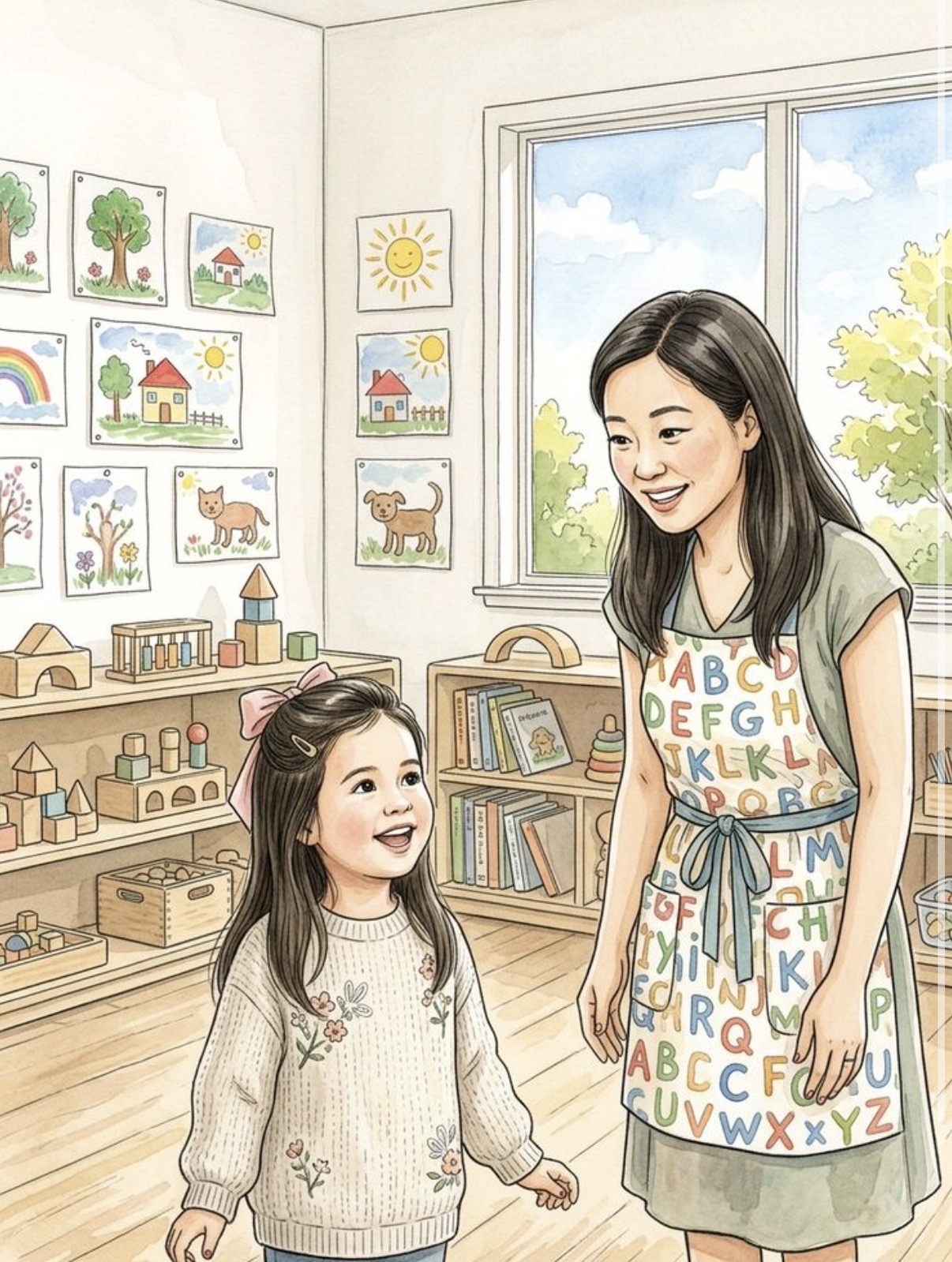
The first day of daycare or preschool is one of the biggest transitions in a young child's life. One day they're home with the people they know best, and the next they're in a new building, with new adults, surrounded by kids they've never met.
For some children, it goes smoothly. For many others, it involves clinging, crying, and a drop-off that breaks both the child's heart and the parent's.
But it doesn't have to be that way. With the right preparation, you can help your child walk into that classroom feeling safe, curious, and ready.
The children who adjust fastest to daycare aren't the "toughest." They're the ones who knew what to expect.
Why starting daycare is so hard for kids
It helps to understand what your child is actually experiencing. To them, starting daycare or preschool can feel like:
- Abandonment. They don't fully understand that you're coming back. The concept of "I'll pick you up after lunch" is abstract to a 2 or 3-year-old.
- Sensory overwhelm. A room full of children is louder, busier, and more chaotic than home. New smells, new sounds, new textures everywhere.
- Loss of routine. Everything they know about their day, meals at the kitchen table, nap in their own bed, playing with their own toys, is suddenly different.
- Stranger anxiety. The teachers are kind, but they're strangers. Trusting a new adult takes time, especially for toddlers.
This isn't a sign that something is wrong with your child. It's a completely normal response to a completely new situation.
How long does it take a child to adjust to daycare?
Most children take between 2-6 weeks to fully adjust to daycare or preschool. Some settle in within days, while others may need a couple of months. Factors that affect the timeline include:
- Age. Younger toddlers (12-18 months) often experience more separation anxiety than older preschoolers (3-4 years).
- Temperament. Some children are naturally more adaptable. Others need more time to warm up to new environments.
- Previous experience. Children who've been in group settings before (playgroups, babysitters, family gatherings) tend to adjust faster.
- Preparation. Children who have been introduced to the concept of daycare through visits, conversations, and stories adjust significantly faster than those who aren't prepared.
That last point is the one you can control. Preparation is the single most effective thing you can do.
What to do before the first day
Start preparing at least 1-2 weeks before your child's first day. Here's what helps:
Visit the daycare together. Walk through the building. Show your child where they'll eat, play, nap, and where you'll pick them up. Let them touch the toys, see the cubbies, and meet a teacher. Familiarity reduces fear.
Talk about it positively (but honestly). Say things like "You're going to a place called daycare where you'll play with other kids and learn new things." Don't oversell it ("You'll LOVE it!") and don't minimize their feelings ("There's nothing to be scared of").
Practice separation. If your child isn't used to being away from you, start with short separations. Leave them with a grandparent or trusted friend for an hour, then two hours. Build up gradually.
Establish the new routine early. If daycare starts at 8am, start waking your child at that time a week before. Practice the morning routine: getting dressed, eating breakfast, putting on shoes, getting in the car.
Read a social story about starting daycare. This is one of the most effective preparation tools available. A social story walks your child through exactly what their first day will look like, from drop-off to pick-up, in calm and reassuring language.
How social stories help with the daycare transition
A social story about starting daycare answers every question your child has but can't articulate:
- Where am I going?
- Who will be there?
- Where will Mommy/Daddy go?
- Will they come back?
- What will I eat?
- Where will I sleep?
- What if I feel sad?
By answering these questions in advance, through a simple illustrated story your child can revisit again and again, you replace the unknown with something familiar. The classroom isn't a strange new place anymore. It's the place from their story.
Children process the world through stories. A social story turns "scary new place" into "the place I already know about."
Research consistently shows that narrative-based preparation reduces anxiety in young children facing transitions. Social stories are one of the most widely recommended tools by early childhood educators and child psychologists for exactly this reason.
What a daycare social story looks like
Here's an example of what a personalized social story for starting daycare might include:
"Soon I'm going to start going to a new place called daycare. Daycare is a place where kids play, learn, and make new friends."
"Mommy will drive me to daycare in the morning. When we get there, I'll hang my bag on my very own hook."
"My teacher's name is Ms. Sarah. She's very nice and she'll help me if I need anything."
"At daycare, I'll get to play with toys, read books, sing songs, and play outside. There will be other kids there too."
"At lunchtime, I'll sit at a table with the other kids and eat my food. After lunch, I might take a nap on a cozy mat."
"If I feel sad or miss Mommy, I can tell my teacher. It's okay to feel sad sometimes. Ms. Sarah will help me feel better."
"At the end of the day, Mommy will come back to pick me up. She always comes back."
That last line, "She always comes back," is one of the most important sentences in any daycare social story. It directly addresses the child's deepest fear.
How to handle drop-off (the hardest part)
Drop-off is where most parents struggle. Here's what the research and experienced educators recommend:
Keep it short and confident. A long, drawn-out goodbye gives your child more time to escalate. Say "I love you, I'll be back after lunch" and go. Your confidence signals to your child that this is safe.
Create a goodbye ritual. A special handshake, a kiss on each palm, or a phrase you always say. Rituals create predictability, and predictability creates calm.
Don't sneak out. It might seem easier, but if your child turns around and you're gone, it destroys trust. Always say goodbye, even if it triggers tears.
Trust the teachers. In most cases, children stop crying within minutes of the parent leaving. The teachers have seen this hundreds of times and know how to comfort your child.
Don't come back to check. If you return because you heard crying, you teach your child that crying brings you back. Call the daycare if you need reassurance, but don't reappear.
Reference the story. "Remember your story? You're going to hang up your bag, just like we read about." Connecting the real experience to the story activates the familiarity your child built during reading.
How Piko Story helps with the daycare transition
Creating an effective preparation story for daycare means capturing your child's specific situation: their name, what they look like, the name of their daycare, their teacher's name, the details of their routine. Generic stories help a little. Personalized stories help a lot.
Piko Story lets you create a fully illustrated, personalized preparation story in minutes. You describe the situation ("my 2-year-old son is starting daycare next week, his teacher is Ms. Sarah") and the app generates a complete story with:
- A character that looks like your child
- Scenes covering arrival, classroom, meals, nap time, play, and pick-up
- Reassuring language about separation and reunion
- Age-appropriate vocabulary matched to your child's level
- Illustrations that keep toddlers engaged during repeat readings
Most parents read the story every night for a week before the first day. By day one, the child has already "been" to daycare dozens of times in their mind.
Week-by-week: What to expect during the adjustment
Here's a realistic timeline so you know what's normal:
Week 1: The hardest week. Expect crying at drop-off, clinginess, and possibly disrupted sleep or appetite at home. This is normal. Your child is processing a massive change.
Week 2: Small improvements. Drop-offs may still be tearful, but the crying stops faster. Your child may start mentioning a friend's name or a toy they liked.
Week 3-4: Settling in. Most children start showing excitement about daycare. They may still have hard moments, but the overall trend is positive. They're building relationships with teachers and peers.
Week 5-6: The new normal. Daycare becomes part of the routine. Drop-offs are smoother. Your child talks about what they did during the day. They have a cubby, a friend, a favorite activity.
If your child is still deeply distressed after 6-8 weeks, it's worth talking to the daycare staff and your pediatrician to explore whether additional support would help.
Tips for parents (because this is hard for you too)
Starting daycare isn't just a transition for your child. It's a transition for you. A few things that help:
- It's okay to feel guilty. Almost every parent does. Guilt doesn't mean you're making the wrong choice.
- Don't project your anxiety. Children pick up on your emotions. If you're calm and positive, they'll take that cue.
- Ask for photos. Many daycares will send photos during the day so you can see your child playing and happy.
- Connect with other parents. They're going through the same thing. Shared experience helps.
- Give it time. The first week is not representative of the whole experience. Most families look back and wonder what they were so worried about.
Frequently asked questions
How do I prepare my 2-year-old for daycare?
Start 1-2 weeks before. Visit the daycare together, practice your morning routine, do short separations with other trusted adults, and read a social story about daycare every day. Focus on making the concept familiar before the first day arrives.
Why does my child cry at daycare drop-off?
Crying at drop-off is a normal expression of separation anxiety. Your child is telling you they'll miss you, which is actually a sign of healthy attachment. Most children stop crying within 5-10 minutes of the parent leaving. A consistent goodbye ritual and prior preparation through social stories can significantly reduce drop-off tears.
How long does daycare adjustment take?
Most children adjust to daycare within 2-6 weeks. Some settle in faster, while others, particularly younger toddlers or children who haven't been in group settings before, may need up to 2 months. Preparation before the first day, including social stories and pre-visits, is the most effective way to shorten the adjustment period.
Is it normal for a child to cry for weeks at daycare?
Some crying during the first 2-3 weeks is completely normal. If your child is still crying intensely at drop-off after 4-6 weeks with no improvement, talk to the daycare staff about what happens after you leave. Often children recover quickly but the transition moment remains hard. If distress continues throughout the day, consult your pediatrician.
What is the best age to start daycare?
There's no single "best" age. Children start daycare successfully anywhere from 6 months to 4 years. Younger babies (under 12 months) often adapt quickly because they haven't yet developed strong separation anxiety. Toddlers (12-24 months) tend to have the hardest time due to peak separation anxiety. Preschoolers (3-4 years) usually adjust well because they can understand explanations and are socially motivated. Preparation matters more than age.
How do I stop my toddler from clinging at daycare drop-off?
Keep your goodbye short, warm, and confident. Create a consistent goodbye ritual (a special phrase, two kisses, a high-five). Don't linger, and don't come back after saying goodbye. Before the first day, read a social story that includes the drop-off moment so your child knows exactly what will happen and that you will return.
What is a social story and does it help with daycare anxiety?
A social story is a short, illustrated narrative that explains a specific situation to a child in simple, reassuring language. For daycare, it covers what the building looks like, what the child will do, who will be there, where they'll eat and nap, and most importantly, that their parent will come back. Social stories are recommended by child psychologists and early childhood educators as one of the most effective tools for reducing transition anxiety.
Should I stay with my child on the first day of daycare?
Many daycares offer a gradual start where you stay for a short period on the first day or two. This can help your child associate the space with your presence before experiencing it alone. Follow your daycare's guidance, but avoid staying too long, as it can make the eventual separation harder. The goal is a smooth handoff to the teacher, not an extended visit.
How do I explain daycare to a toddler who doesn't fully understand words yet?
Use simple, concrete language: "You're going to play at a new place. There will be toys and kids and a nice teacher." Pair words with visuals. A social story with illustrations is especially powerful for pre-verbal or early-verbal toddlers because they process pictures before they process complex sentences. Point to the illustrations and narrate simply: "Look, that's you! You're playing with blocks."
My child was fine at daycare but now suddenly hates it. What happened?
Regression is common and can happen weeks or even months after starting. Triggers include illness, a schedule change, a new teacher, a conflict with another child, or a developmental leap. Don't panic. Return to your preparation tools: re-read the social story, talk to the teachers about what might have changed, and give your child extra reassurance at drop-off. Most regressions resolve within 1-2 weeks.