Parents often discover social stories through a therapist's recommendation or a blog post, and they try one because it sounds reasonable. Then something surprising happens: it actually works. Their child, who screamed through every haircut, sits calmly in the chair. Their toddler, who clung desperately at daycare drop-off, waves goodbye and walks in.
It feels almost too simple. A short story with pictures, read a few times before an event, and the child's behavior changes? How?
The answer is that social stories tap into some of the most fundamental mechanisms in the human brain. The science behind them isn't new or fringe. It draws from decades of research in neuroscience, developmental psychology, and cognitive behavioral science.
Stories aren't just entertainment. They're how the human brain makes sense of the world, and children's brains are built to learn this way.
The brain processes stories differently than instructions
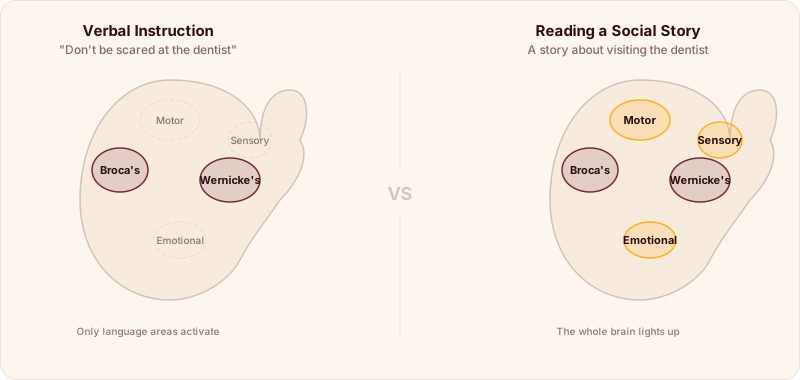
When you tell a child "don't be scared at the dentist," you're giving them a directive. Their brain processes it as language, activating Broca's and Wernicke's areas (the language processing regions) and not much else.
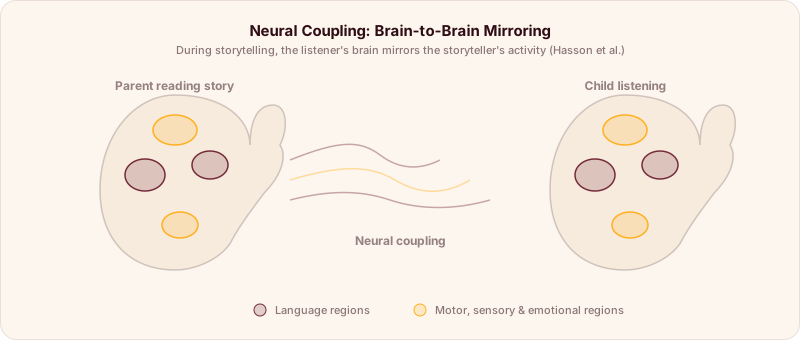
But when you read them a story about going to the dentist, something dramatically different happens. Research by Uri Hasson and his team at Princeton University found that during storytelling, the listener's brain activity begins to mirror the storyteller's brain activity, a phenomenon called neural coupling (Hasson et al., 2010, "Brain-to-brain coupling: a mechanism for creating and sharing a social world," Trends in Cognitive Sciences).
This means that when a child hears a story about sitting in the dentist's chair, their brain simulates the experience as if they were actually there. The motor cortex activates when the character walks into the office. The sensory cortex activates when the story describes the sound of the drill. The emotional centers activate when the character feels nervous, and then calm.
A story doesn't just inform a child about what will happen. It lets their brain practice the experience.
Stories trigger oxytocin and build trust
Paul Zak, a neuroeconomist at Claremont Graduate University, conducted a series of studies on what happens in the body during storytelling. His research found that character-driven stories consistently trigger the release of oxytocin, the neurochemical associated with empathy, trust, and social bonding (Zak, 2015, "Why Inspiring Stories Make Us React: The Neuroscience of Narrative," Cerebrum).
In his experiments, participants who watched a narrative about a father and his terminally ill son showed significant increases in oxytocin levels compared to those who watched a non-narrative description of the same situation. More importantly, the oxytocin increase predicted subsequent prosocial behavior: people who experienced the narrative were more likely to donate to charity and cooperate with strangers.
For children, this has direct implications. When a child reads a social story featuring a character they identify with (especially one that looks like them), the oxytocin response strengthens their sense of safety and trust. The story doesn't just explain the situation. It makes the child feel that the situation is manageable.
Mental simulation: stories as practice runs
One of the most powerful findings in storytelling research comes from the work of Raymond Mar at York University. His research demonstrates that reading narrative fiction activates the same brain networks used for understanding real social situations, a process called mental simulation (Mar & Oatley, 2008, "The Function of Fiction is the Abstraction and Simulation of Social Experience," Perspectives on Psychological Science).
In other words, when a child reads a story about their first day at preschool, their brain treats it as a low-stakes rehearsal. They mentally walk through the hallways, sit in the circle, eat lunch at the little table, and wave goodbye to their parent, all from the safety of their own living room.
This is why social stories are so effective for anxiety. The unfamiliar becomes familiar through mental rehearsal. By the time the child actually experiences the situation, their brain has already processed it multiple times. The "unknown" that triggers fear has been replaced with a mental model of what to expect.
Transportation theory: why children "enter" stories
Melanie Green and Timothy Brock's research on narrative transportation explains why stories are more persuasive and more memorable than facts alone (Green & Brock, 2000, "The Role of Transportation in the Persuasiveness of Public Narratives," Journal of Personality and Social Psychology).
Transportation is the state of being "absorbed" in a story, where the reader mentally enters the narrative world. Green and Brock found that the more transported a person is into a story, the more their real-world beliefs and attitudes shift to align with the story's message.
Children are especially susceptible to narrative transportation because:
- They have fewer competing mental models. An adult at the dentist has decades of experience to draw from. A child may have none. The story becomes their primary reference point.
- They naturally engage in pretend play. Children are already wired to enter imaginary worlds. A social story meets them in a mode of thinking they're already comfortable with.
- They identify strongly with characters. When a story features a character who looks like them and faces the same situation, the transportation effect is amplified.
This is why personalized social stories are more effective than generic ones. The closer the story matches the child's reality, the deeper the transportation, and the stronger the effect.
Carol Gray's Social Stories™ framework and the evidence behind it
Carol Gray developed the Social Stories™ methodology in 1991 while working as a consultant for children with autism in Michigan. Her framework isn't just a template. It's built on specific principles designed to maximize comprehension and minimize anxiety (Gray, 2010, "The New Social Story™ Book," Future Horizons).
The key components of Gray's framework include:
- A 2:1 ratio of descriptive/perspective sentences to directive sentences. This ensures the story feels informative rather than instructional. Children respond better to understanding than to being told what to do.
- First-person or third-person perspective. This allows the child to see themselves in the story.
- Positive and patient tone. Directive sentences use "can" and "might" rather than "will" and "must," preserving the child's sense of agency.
- Accurate, literal descriptions. Children, especially those on the autism spectrum, need information they can trust. Exaggeration or metaphor can undermine the story's effectiveness.
A meta-analysis by Kokina and Kern (2010, "Social Story™ Interventions for Students with Autism Spectrum Disorders: A Meta-Analysis," Journal of Autism and Developmental Disorders) examined 18 studies and found that Social Stories™ were effective in improving social behavior in the majority of cases. The intervention was most effective when stories were personalized, read multiple times, and paired with visual supports.
Why illustrations matter: the dual coding advantage
Social stories with illustrations aren't just more engaging. They're more effective, and the reason is rooted in Allan Paivio's dual coding theory (Paivio, 1986, "Mental Representations: A Dual Coding Approach," Oxford University Press).
Dual coding theory holds that the brain processes verbal information and visual information through two separate but connected channels. When a child receives information through both channels simultaneously (hearing a story while seeing illustrations), the memory trace is significantly stronger than either channel alone.
For social stories, this means:
- Better recall. A child who sees an illustration of the dentist's chair while hearing about it is more likely to remember the information when they actually sit in the chair.
- Deeper comprehension. Illustrations fill in gaps that language leaves open. A child may not fully understand "the hygienist will use a small mirror," but an illustration makes it immediately clear.
- Reduced cognitive load. Processing a story through two channels is actually easier than processing it through one, because each channel handles part of the work.
This is why illustrated social stories consistently outperform text-only stories in research, and why visual support is considered essential for children under 6.

Repetition and predictability: how stories rewire expectations
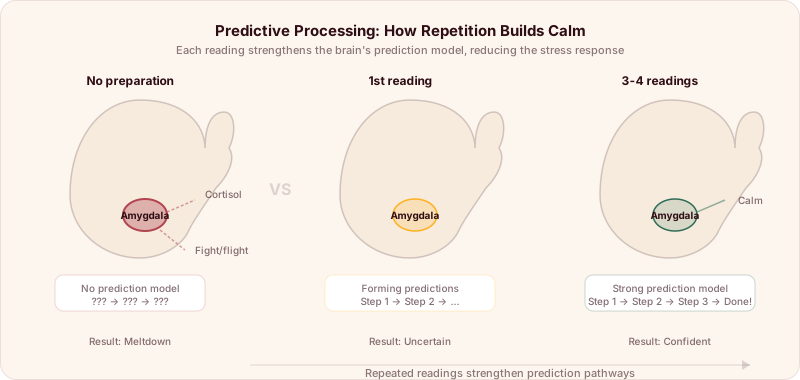
Neuroscience research on predictive processing shows that the brain is fundamentally a prediction machine. It constantly generates expectations about what will happen next, and anxiety occurs when predictions fail or can't be generated at all (Clark, 2013, "Whatever next? Predictive brains, situated agents, and the future of cognitive science," Behavioral and Brain Sciences).
For a child facing a new situation, the brain has no prediction model. It doesn't know what the barber shop looks like, what the clippers sound like, or what will happen after the cape goes on. This prediction failure triggers the stress response: cortisol rises, the amygdala activates, and the child enters fight-or-flight mode. That's the meltdown.
A social story, read repeatedly, builds a prediction model. Each reading strengthens the neural pathways associated with the sequence of events. By the third or fourth reading, the child's brain has a reliable model: first this happens, then this, then this. The situation is no longer unpredictable. The stress response doesn't activate.
This is also why reading the story once isn't enough. The research on memory consolidation shows that repeated exposure, especially across multiple days, strengthens the neural representation far more than a single exposure (Ebbinghaus spacing effect).
Social stories across neurotypes: the universal mechanism
While social stories were originally developed for children with autism, the underlying mechanisms (neural coupling, mental simulation, narrative transportation, dual coding, predictive processing) are universal. They operate in every human brain.
Research by Lorimer Moseley and colleagues has shown that narrative-based interventions reduce anxiety and improve outcomes across a wide range of populations, not just those with clinical diagnoses. A study by Fearnley (1997, "Helping Children Cope with Fear and Anxiety through Stories," Bereavement Care) demonstrated that social stories helped neurotypical children cope with grief and loss.
More recently, a growing body of evidence supports the use of social stories for:
- Children with ADHD who benefit from clear, structured expectations
- Children with anxiety disorders who need to pre-process potentially stressful situations
- Neurotypical toddlers who are encountering experiences for the first time
- Children with sensory processing differences who need to understand what sensory experiences to expect
The common thread isn't diagnosis. It's that the child faces a situation where the unknown creates distress, and a story replaces that unknown with understanding.
How Piko Story applies the research
Every story generated by Piko Story is built on these principles:
- Personalized characters that trigger stronger identification and narrative transportation
- Illustrated scenes that activate dual coding for better recall and comprehension
- Carol Gray's Social Stories™ framework of descriptive, perspective, and directive sentences in the right ratio
- Step-by-step sequencing that builds the predictive model your child's brain needs
- Positive, patient tone that promotes oxytocin release and a sense of safety
- Designed for repeated reading so each session strengthens the neural pathways
You don't need to understand the neuroscience to use a preparation story. But it helps to know that when you read one to your child, you're not just telling them a story. You're giving their brain exactly what it needs to feel prepared.
References
- Clark, A. (2013). Whatever next? Predictive brains, situated agents, and the future of cognitive science. Behavioral and Brain Sciences, 36(3), 181-204.
- Fearnley, R. (1997). Helping children cope with fear and anxiety through stories. Bereavement Care, 16(1), 5-7.
- Gray, C. (2010). The New Social Story™ Book. Future Horizons.
- Green, M. C., & Brock, T. C. (2000). The role of transportation in the persuasiveness of public narratives. Journal of Personality and Social Psychology, 79(5), 701-721.
- Hasson, U., Ghazanfar, A. A., Galantucci, B., Garrod, S., & Keysers, C. (2012). Brain-to-brain coupling: A mechanism for creating and sharing a social world. Trends in Cognitive Sciences, 16(2), 114-121.
- Kokina, A., & Kern, L. (2010). Social Story™ interventions for students with autism spectrum disorders: A meta-analysis. Journal of Autism and Developmental Disorders, 40(7), 812-826.
- Mar, R. A., & Oatley, K. (2008). The function of fiction is the abstraction and simulation of social experience. Perspectives on Psychological Science, 3(3), 173-192.
- Paivio, A. (1986). Mental Representations: A Dual Coding Approach. Oxford University Press.
- Zak, P. J. (2015). Why inspiring stories make us react: The neuroscience of narrative. Cerebrum, 2015, 2.
Frequently asked questions
Are social stories scientifically proven?
Yes. Social stories are supported by multiple lines of research, including neuroscience (neural coupling, predictive processing), psychology (narrative transportation, mental simulation), and clinical studies. A meta-analysis by Kokina and Kern (2010) found social stories to be effective in the majority of studied cases, particularly when personalized and read multiple times with visual support.
Why do social stories work better than just explaining things to kids?
When you explain something verbally, only the language centers of the brain activate. When a child hears a story, their brain simulates the experience: motor, sensory, and emotional regions all activate as if the child were living through the event. This "mental rehearsal" is far more effective at reducing anxiety than verbal reassurance.
Do social stories only work for kids with autism?
No. While social stories were originally developed for children with autism, the brain mechanisms they rely on (neural coupling, narrative transportation, dual coding) are universal. Research shows social stories benefit neurotypical children, children with ADHD, children with anxiety, and any child facing an unfamiliar situation.
Why do illustrated social stories work better than text-only stories?
Dual coding theory (Paivio, 1986) shows that the brain processes visual and verbal information through two separate channels. When both channels receive information simultaneously, memory and comprehension are significantly stronger. For young children who are still developing reading skills, illustrations are especially important for understanding and recall.
How many times should you read a social story for it to work?
Research on memory consolidation and predictive processing suggests that 3-5 readings spread across multiple days is most effective. Each reading strengthens the neural pathways associated with the expected sequence of events. A single reading helps, but repeated exposure is what builds the reliable prediction model that prevents anxiety.
Why does personalization make social stories more effective?
Research on narrative transportation (Green & Brock, 2000) shows that the more a reader identifies with a story's character and setting, the deeper their absorption into the narrative. When a child sees a character that looks like them, in a setting that matches their real situation, the mental simulation is stronger and the resulting preparation is more effective.
What age do social stories start working?
Social stories can be effective from around 18-24 months onward, though the format should be adapted. For toddlers, very short stories (3-5 sentences) with large illustrations are most effective. As children develop language and comprehension, stories can become longer and more detailed. The underlying mechanisms (visual learning, pattern recognition, predictive processing) are active from early infancy.
Can reading a social story once before an event help?
A single reading is better than no preparation, but research shows the effect is significantly stronger with repeated readings. If you only have time for one reading, pair it with conversation: talk about the story, ask your child what they remember, and reference it during the actual event ("Remember your story? This is the part where...").
Is there a difference between social stories and regular children's books about situations?
Yes. Social Stories™ follow a specific framework (developed by Carol Gray) that emphasizes descriptive and perspective sentences over directive sentences, uses accurate rather than exaggerated language, and is designed for a specific child's specific situation. Generic children's books about "going to the dentist" can help, but personalized social narratives that match the child's exact experience are consistently more effective in research.
Where can I find the research papers cited in this article?
All references are listed in the References section above with full citation details including authors, publication year, title, and journal. These papers are available through academic databases such as Google Scholar, PubMed, and university library systems. Many are also available as open-access PDFs through the authors' institutional pages.