I'm going to be honest. There was a moment last month where I was completely at a loss.
My 4-year-old and 2-year-old were fighting over a toy. Again. For what felt like the hundredth time that day. My daughter would grab something, my son would want it, she'd snatch it back, he'd scream, and I'd be standing there trying to referee a conflict between two tiny people who don't yet understand the concept of sharing.
I tried everything. I tried explaining. I tried the timer method. I tried redirecting. I tried the "we don't grab" speech so many times I could recite it in my sleep. Nothing was sticking.
That night, after they were both finally in bed, I sat down and thought about it differently.
What if I just turned it into a story?
I'm an occupational therapist, so I know how children learn. I know that lecturing a 4-year-old in the heat of the moment doesn't work. Their brains are flooded. They can't process a lesson when they're upset.
But stories? Stories reach kids in a completely different way. When a child hears a story, they're calm. They're curious. They're absorbing.
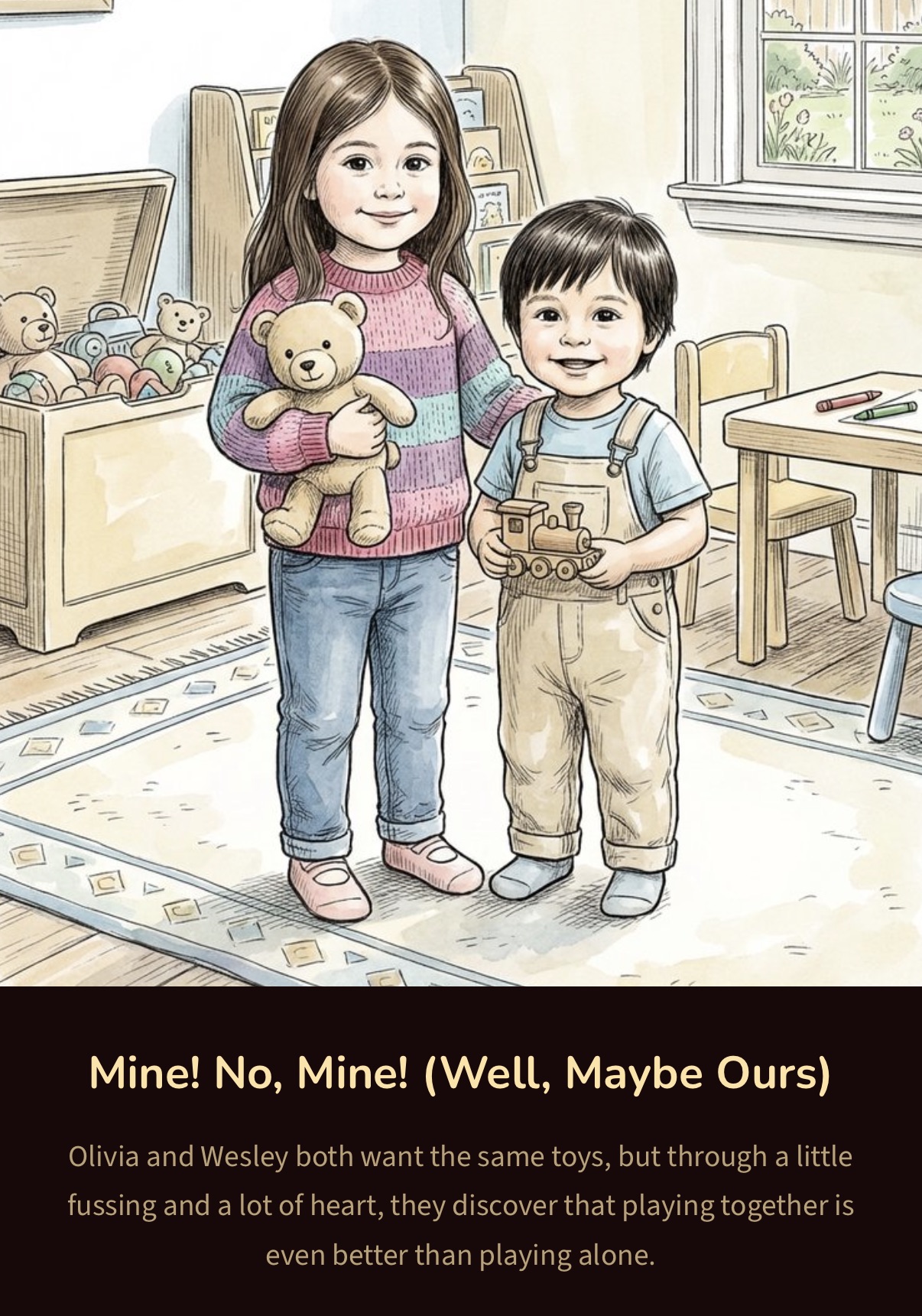
So that night, during a quiet moment after the kids were asleep, I sat down and created a simple story. It was about two siblings, a big sister and a little brother, who both wanted to play with the same toy. The sister grabbed it, the brother cried, and then something shifted. The big sister had an idea. She showed her brother how to play with it together. They took turns. They laughed. And at the end, playing together turned out to be way more fun than playing alone.
That was it. Nothing fancy. Just a short story that mirrored exactly what was happening in our house, but with a different ending.
What happened the next morning
I read the story to my daughter at breakfast. She was into it immediately. She pointed at the pictures, asked questions, and at one point said "that's like me and brother."
That was the moment I knew she got it.
Later that day, they were playing and the same situation started to unfold. My son reached for something she was holding, and I braced myself. But instead of snatching it away, she paused. Then she said "here, we can share it."
I almost fell over.
Was it perfect? No. She's four. There were still moments. But the shift was real. She was more patient. She stopped grabbing things away from him. She started including him in her play instead of treating him like an interruption.
She didn't learn it from my lecture. She learned it from a story.
Why I think it worked
I've thought about this a lot since that day, both as a mom and as a therapist. Here's what I think happened.
When I tried to teach sharing in the moment, my daughter was already upset. Her brain was in fight mode. She couldn't hear me, no matter how calmly I said it.
But when she heard the story, she was relaxed. She was safe. She wasn't being corrected or told she did something wrong. She was just listening to a story about two kids who figured something out. And she connected to it on her own.
That's the thing about stories. You're not telling your child what to do. You're showing them a version of themselves making a good choice. And kids want to be that version.
The lesson I took from it
I realized that night that I'd been approaching the problem backwards. I was trying to teach in the hardest possible moment, when emotions were high and no one was listening. The story let me take the lesson I wanted to teach and deliver it at a time when my daughter could actually receive it.
Now I do this all the time. If there's a behavior I want to work on or a situation coming up that might be tricky, I make a story about it. Bedtime struggles, being gentle with the dog, what to do when you're frustrated. It doesn't always work perfectly, but it works so much better than anything else I've tried.
I took the lesson I wanted to teach and turned it into a story. That small shift changed everything.
You don't have to be a therapist to do this
I happen to have a background in child development, but honestly, that's not what made this work. What made it work was knowing my kids. I knew the exact situation. I knew what triggered it. I knew what outcome I was hoping for. Any parent knows those things.
If your kids are struggling with something, whether it's sharing, bedtime, a new school, or anything that feels hard to explain, try turning it into a story. You might be surprised what happens.
That's actually how Piko Story was born. Around the same time I was discovering this at home, Mike got laid off from his software development job. It was scary, but it was also one of those moments where we looked at each other and said, "what if we bet on ourselves?" We'd always talked about starting something together, and suddenly the timing felt right.
So we combined what we each bring to the table. I understand how kids learn, how they process new information, and what makes a story actually work for a child. Mike knows how to build things and turn an idea into something real. Together we created Piko Story so that any parent can take a situation, describe it in a few words, and have a personalized illustrated story ready in minutes. No writing skills required. No clip art. Just a real story, for your real kid, about their real life.
It changed things for our family. I hope it can do the same for yours.